
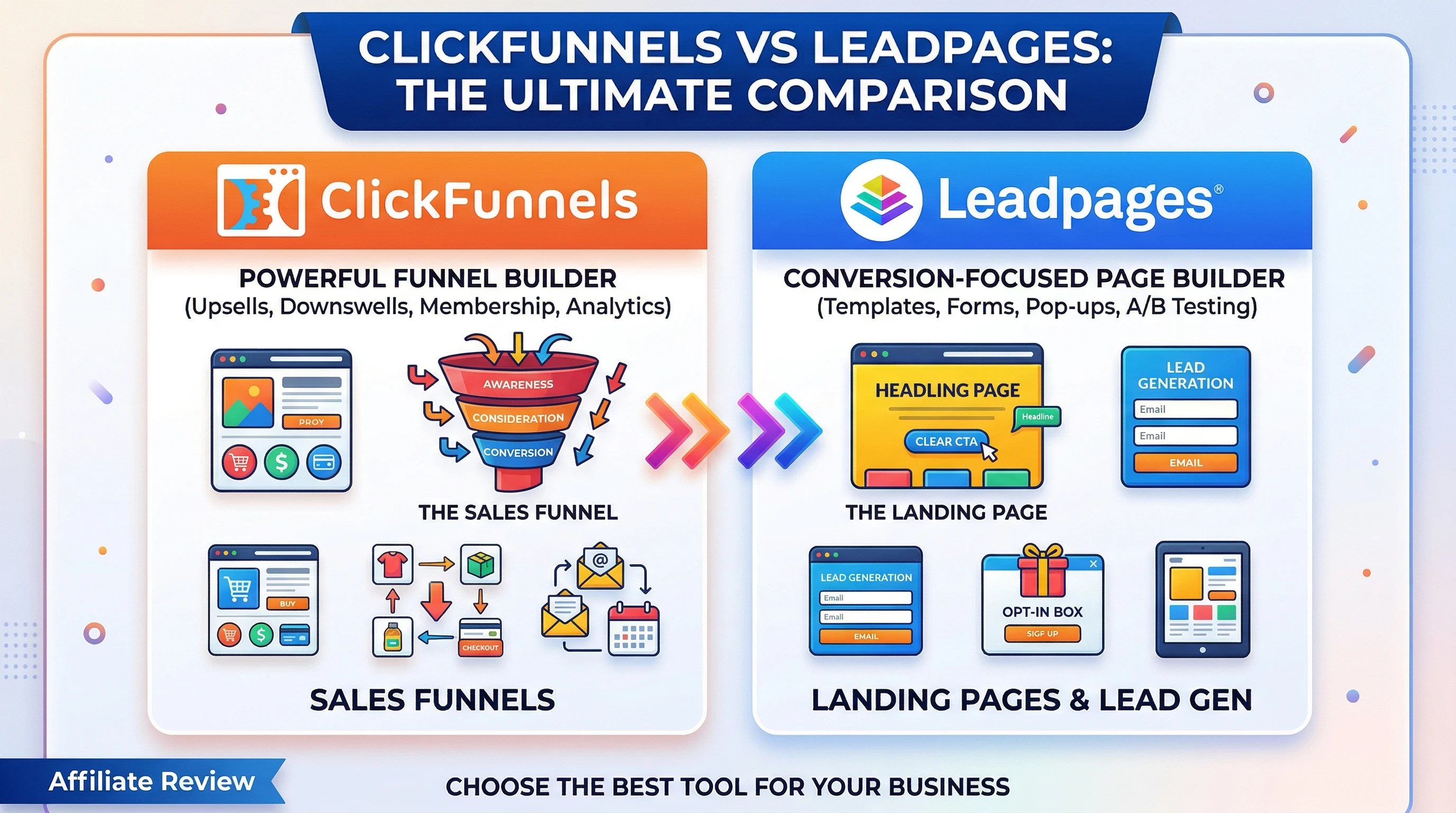
For affiliate marketers, choosing the right funnel builder can be a gamechanger. ClickFunnels and Leadpages are top names in this space, each giving you solid tools to create high converting landing pages, sales funnels, and optin forms. The tools seem similar at first glance, but when you check out the specifics, you’ll notice some practical differences that shape your workflow and results.
I’ve put both platforms to the test while promoting affiliate offers, so I know their strengths and weak points from an affiliate’s perspective. ClickFunnels has a reputation for guiding users through entire sales processes with minimal tech skills, while Leadpages makes it easy to get high converting pages online fast. If you’re wondering which one to choose, this comparison covers features, pricing, usability, and which tool suits different affiliate needs best.
Overview of ClickFunnels and Leadpages
What is ClickFunnels?
ClickFunnels helps users create complete sales funnels, tying together landing pages, checkout processes, upsells, downsells, and email automation in one platform. It’s built for anyone selling products, courses, or memberships. You can string together a sequence of pages to guide visitors from signup to sale, using a drag and drop builder that doesn’t require any coding knowledge.
Who is ClickFunnels Best For?
- Affiliates who want to build complete funnels with upsells and integrated email followups
- Marketers who sell multiple products or offers on one platform
- Anyone looking for advanced automation such as order bumps, webinars, or splittesting
ClickFunnels Pros & Cons
Pros:
- Allinone platform for funnels (landing pages, checkout, automation)
- Lots of templates designed for conversions
- Built in affiliate management (for your own offers)
Cons:
- More expensive than many alternatives
- Can feel overwhelming for simple landing page needs
- Load times can be slower than some competitors
What is Leadpages?
Leadpages focuses on helping users quickly launch high converting landing pages and optin forms. While it doesn’t include full funnel automation like ClickFunnels, its intuitive fast builder, strong library of templates, and simple integrations with email marketing tools make it stand out. It’s a popular pick among bloggers, coaches, and affiliates who want pages live in minutes.
Who is Leadpages Best For?
- Affiliates just starting out who want something easy and reliable
- Marketers who are mainly collecting leads for email marketing
- Anyone who likes an affordable option for landing page creation
Leadpages Pros & Cons
Pros:
- Builder is easy to use even for beginners
- Fast load times (helps with conversions)
- Affordable pricing, especially for singlesite users
Cons:
- No true funnel building (no builtin checkout or advanced automation)
- Limited upsell or cross sell options within a funnel sequence
- Fewer customization options compared to ClickFunnels
ClickFunnels vs Leadpages: Feature Comparison
- Funnel Building and Automation
Why It Matters: Affiliates usually need more than just landing pages. Combining pages into funnels, tracking conversions, and automating followups can give your results a boost.
ClickFunnels: Lets you build multistep funnels including upsells, downsells, checkout pages, and webinar pages. Automation connects landing pages to email sequences and sales actions.
Leadpages: Focused on creating strong landing pages and popups, but no full funnel linking or order forms.
My Take: ClickFunnels is best for full funnels. Leadpages does well if you only need single high converting pages. - Design Flexibility and Templates
Why It Matters: Eye catching pages get better conversions. Templates save time and help those without a design background.
ClickFunnels: Plenty of templates designed for conversion, covering optins, sales, webinars, and more. Drag and drop builder, but advanced features may take more learning.
Leadpages: Large library of modern templates optimized for conversions. Inline editing makes changes quick and painless.
My Take: Leadpages is easier for quick page launches, with an edge for beginner usability. ClickFunnels gives more flexibility but takes a bit longer to master. - Integrations and Compatibility
Why It Matters: Affiliates use email systems, webinar tools, and CRMs. Smooth integration helps automate marketing tasks.
ClickFunnels: Connects with popular email services, CRMs, and Zapier. Some integrations may need Zapier or workarounds.
Leadpages: Natively connects with most top email platforms, CRMs, and webinar tools. Simple setup for list building.
My Take: Leadpages often connects more smoothly to major email tools. ClickFunnels, though, gives you more choices for advanced funnel automation. - Pricing and Value
Why It Matters: Affiliates often start on limited budgets. Getting good value for money is crucial as you build your business.
Plan Comparison (as of early 2024):
ClickFunnels: Starts at $147 per month for the basic plan. Advanced features drive the cost higher.
Leadpages: Starts at $37 per month for Standard, with most needed core features.
My Take: Leadpages is better for smaller budgets or those testdriving a new affiliate idea. ClickFunnels comes with a bigger price tag but gives you allinone funnel building. - Reporting and Analytics
Why It Matters: Affiliates need to keep up with clicks, conversions, and ROI.
ClickFunnels: Offers builtin stats on funnel steps, splittests, and traffic sources.
Leadpages: Gives conversion tracking and a quick connection with Google Analytics.
My Take: Both will cover the basics, but ClickFunnels lets you split test and analyze funnel performance at a deeper level.
User Reviews and Community Reputation
- ClickFunnels: Users give it the thumbs up for managing complex funnels and praise the active user community. Some mention a learning curve and higher monthly costs. There’s plenty of support, from tutorials to Facebook groups.
- Leadpages: Gets positive feedback for being easy, speedy, and having strong customer support. Some yearn for deeper funnel features but see it as a great value. Its community is on the rise, packed with helpful resources for newbies.
Overall Reputation: Both have solid standing. ClickFunnels draws more advanced users who want a complete solution, while Leadpages appeals to those wanting fast, reliable landing pages without tech headaches.
How to Choose: Which Funnel Builder is Right for Affiliates?
Both platforms deliver what most affiliates require, but in different ways. ClickFunnels is your go to if you want to handle multiple offers, run complex sequences, or like having everything in one tool. For high converting landing pages and budget friendly pricing, Leadpages wins in my book.
Go with ClickFunnels if you:
- Plan to manage entire funnels, including upsells, downsells, and order forms
- Have the funds to invest in a robust tool
- Want to run advanced splittests and campaigns
Go with Leadpages if you:
- Want an easy way to launch attractive pages for affiliate marketing
- Care about quick load speed and seamless email marketing integrations
- Are looking for a wallet friendly option when getting started
I’ve found both ClickFunnels and Leadpages handy depending on each project. For new affiliates, Leadpages feels much less overwhelming and is easier to grasp. Those needing more elaborate automation or planning to sell their own products should consider ClickFunnels, even with its higher cost. The real question is about your current needs, budget, and how deep you want to go with automation and funnel strategy.
Do you go for ClickFunnels or Leadpages for your next affiliate adventure?